
A lot of independent brands ask the same question when they're starting out: do I really need a Tech Pack? Can I just explain what I want directly to the factory and skip that step?
The honest answer is: yes, you can brief a factory without one. But you'll pay for it — not necessarily in money, but in time, in repeat sampling costs, and in a final product that's close to what you wanted but not quite there.
How factories actually handle briefs without a Tech Pack
Chinese factories receive dozens of inquiries every day, most of them from buyers who don't fully understand the production process. They've developed a way of handling this: if you send a photo and a few lines of description, the factory will make their best interpretation and proceed. They won't ask you about every detail — that takes too much time. They'll guess.
The result is predictable. Your first sample arrives and the collar sits differently than you pictured, the stitching method isn't what you had in mind, the fabric weight is off. None of this is the factory being difficult. It's the inevitable result of incomplete information.
What you can use instead of a Tech Pack
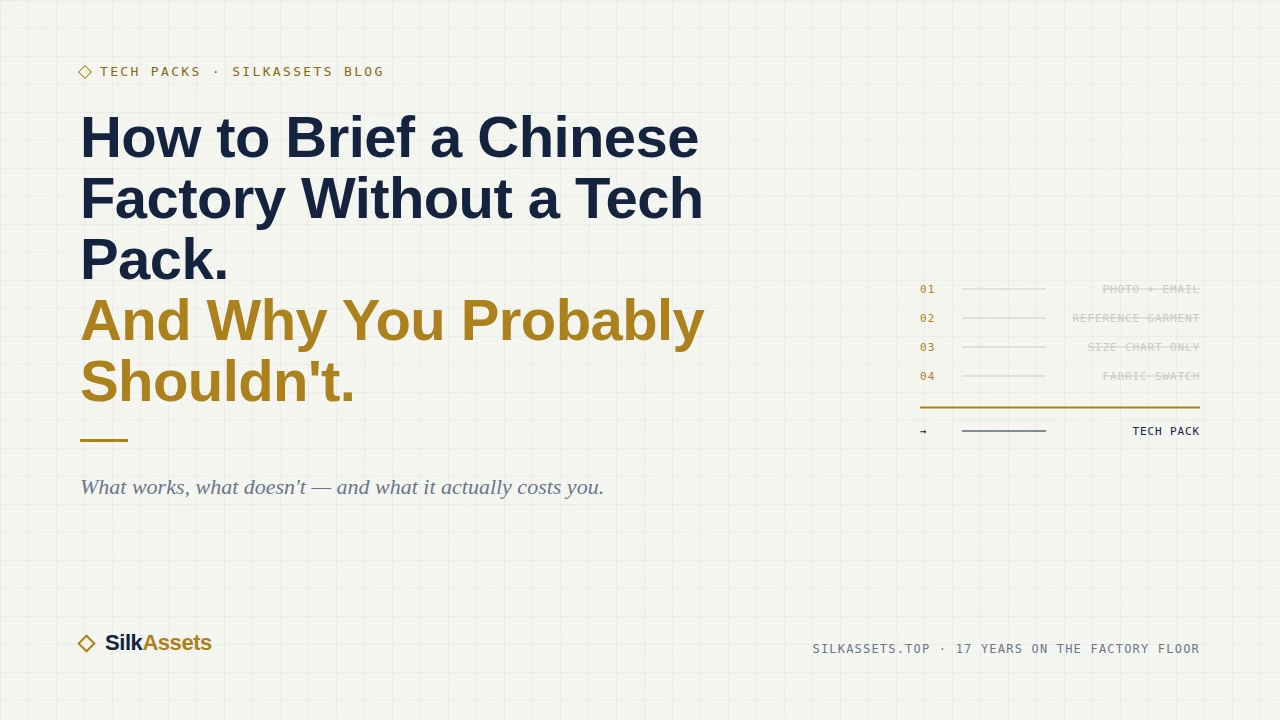
If you genuinely don't have a Tech Pack yet, these four things will get you further than a description alone.
① A reference garment
Send a finished garment you like to the factory and ask them to sample based on it. This is the most direct form of communication available — a physical object eliminates a significant amount of ambiguity. But you still need to specify what to keep, what to change, and what the reference garment gets right that you want to preserve.
② A complete size chart
Even without a full Tech Pack, a detailed measurement chart covering every part of the garment is essential. Don't tell a factory to "make it in a size M." Every factory has a different interpretation of what M means. Give them specific measurements for every point of measure: chest, waist, hip, sleeve length, hem width, armhole depth — everything.
③ A fabric swatch
If you have a specific fabric requirement, send a physical swatch. No written description of a fabric is as clear as the fabric itself. The factory can match weight, hand feel, and structure directly without guessing.
④ Construction detail sketches
For any construction detail you're not confident will be understood — a specific pocket shape, a particular seam finish, a collar construction — draw it. A rough sketch with annotations is worth more than a paragraph of description.
Why these workarounds all have limits
A reference garment communicates silhouette and proportion, but it can't communicate your quality standards, your finish requirements, or your specific construction preferences. The factory will interpret those based on their own defaults.
A size chart solves the measurement problem but leaves structure, fabric, trims, labels, and packaging undefined.
A fabric swatch solves the fabric problem but leaves the pattern undefined.
Each workaround covers one part of the picture. A Tech Pack's value is that it covers all of them at once — a single document that replaces weeks of back-and-forth emails, repeated clarifications, and preventable sample revisions.
What briefing without a Tech Pack actually costs you
The sampling fee isn't the real cost. A sample might run you $100–300. That's manageable.
The real cost is time.
A brand with a complete Tech Pack can move from sample approval to bulk production in six to eight weeks. A brand communicating by email, photo, and description — revising samples, clarifying misunderstandings, correcting details that were never specified — can spend four to six months covering the same ground.
In those four to six months, your competitor has already shipped.
There's also a subtler cost. Every round of sample revision signals to the factory that you don't know exactly what you want. Factories prioritize clients who communicate clearly. A buyer who sends precise documentation gets faster responses, more accurate samples, and more goodwill when problems arise. A buyer who communicates vaguely becomes a low-priority account.
When it's reasonable to skip the Tech Pack
If you're sampling a concept purely to see whether an idea is viable — a small exploratory order, not intended for production — then a full Tech Pack is probably more work than the stage requires. Get the sample, see whether the concept holds up, and build the documentation once you've decided to move forward.
But once you're committing to production, once you're placing a real order with real money, a Tech Pack stops being optional. At that point you're managing risk, and undefined specifications are the most common source of production problems.
The bottom line
You can brief a factory without a Tech Pack. People do it every day. But you're trading efficiency for convenience — using time and repeat sampling to do what documentation would have done faster and more accurately.
If you're ready to stop guessing and start specifying, the Tech Pack template at SilkAssets is built to the standard Chinese factories actually need — not a generic form, but a working document built from 17 years of factory floor experience.