
Most of the numbers you find online about clothing manufacturing costs in China were written by factories. Their goal is to get you to send an inquiry. This article is different. I've spent 17 years inside China's garment supply chain — as a designer, pattern maker, brand founder, sourcing agent, and production manager. I'm going to tell you what the numbers actually look like.
Why the quotes you see online don't mean much
"T-shirts from $2." You've seen this. It's not a lie. But it's only true under a very specific set of conditions: large order volume, the most basic fabric, the simplest construction, and the cheapest factory.
The reality is that the same basic t-shirt can cost $1–2 at a Guangzhou market factory and $5–8 at a brand-quality factory. Same country. Same garment. Five times the price difference. The cheap factory isn't necessarily cheating you — they just serve a completely different kind of client.
The four things that actually determine your cost
&circone; Fabric
Fabric typically accounts for 50–70% of your total unit cost. Plain cotton versus organic cotton: up to 3x the price. Standard polyester versus technical waterproof fabric: up to 5x. Once you've locked in the fabric, you've locked in most of the cost. Everything else is much smaller in comparison.
&circone; Construction complexity
A basic crew-neck tee and a tee with panelling, pockets, and special topstitching have very different labour costs. Factories charge per operation — more steps, higher price. This is why a "simple" garment with ten construction details is never as simple as it looks on paper.
&circone; Order quantity (MOQ)
This is the factor most people underestimate. The same style, the same factory:
- 100 pieces — unit cost might be $15
- 500 pieces — unit cost might be $9
- 2,000 pieces — unit cost might be $6
Smaller orders cost more per piece. For a startup brand, this is unavoidable. Build it into your pricing from the start.
&circone; Factory type and region
China's garment industry is built around regional clusters — different provinces specialise in different product types. The right factory for knitwear is not the same as the right factory for denim or outerwear. Finding your product's cluster is one of the highest-leverage decisions you can make.
The truth about Guangzhou
Guangzhou has the highest international name recognition of any Chinese garment city. It also has the most inconsistent quality. A significant part of why overseas buyers believe "Chinese quality is poor" comes from starting in Guangzhou — which runs on fast fashion speed and volume, not craft or precision.
That said, you cannot avoid Guangzhou entirely. It has the most complete fabric and trim market in the country. Whatever you need — any fabric, any trim, any special finish — you can find it in Guangzhou, often with same-day sourcing. The correct approach for most brands is to source materials in Guangzhou and produce in the right specialist region for your product type.
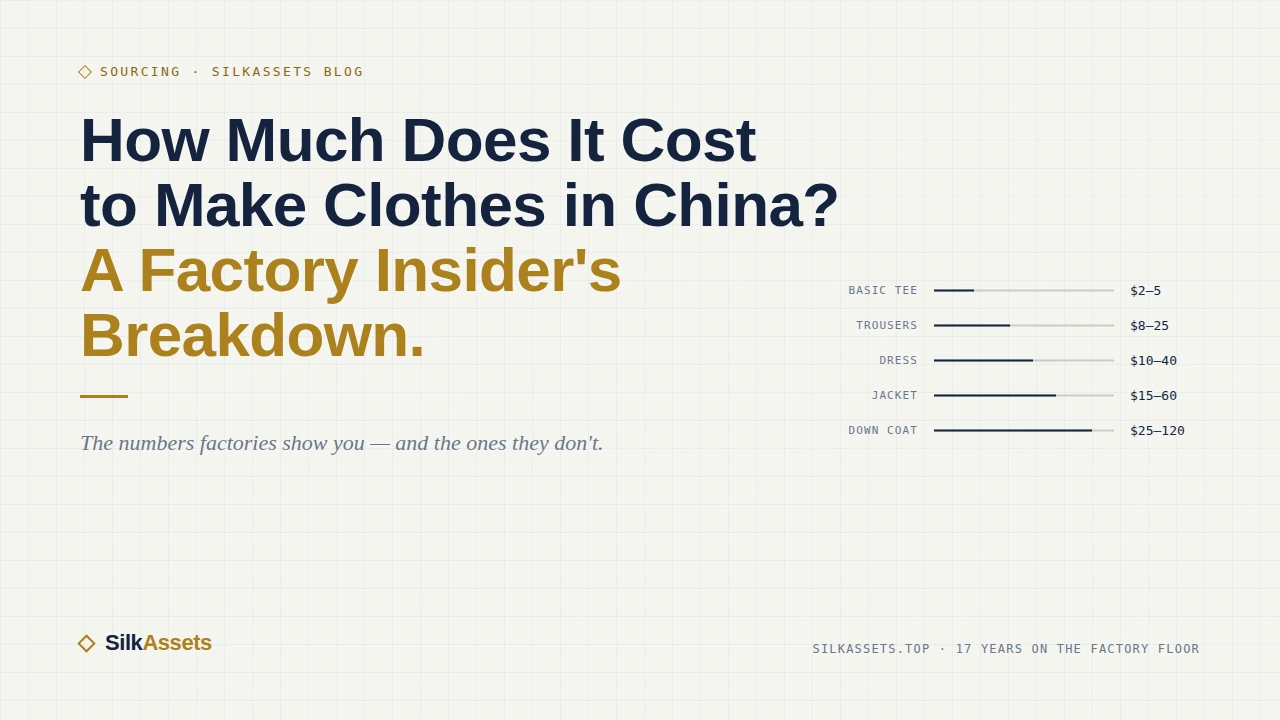
Real price ranges by category (2026)
All prices are EXW (ex-factory), excluding shipping, based on orders of 200–500 units. These are reference ranges — they shift with fabric prices, labour costs, and order specifics.
| Category | Standard factory | Quality factory |
|---|---|---|
| Basic t-shirt | $3–5 | $6–12 |
| Polo shirt | $5–8 | $10–18 |
| Casual trousers | $8–12 | $15–25 |
| Dress | $10–18 | $20–40 |
| Basic jacket | $15–25 | $30–60 |
| Down jacket | $25–40 | $50–120 |
The hidden costs most brands forget
Sample and pattern charges: $50–300 per style
Almost all small factories in China don't have their own pattern makers. Pattern making is outsourced to specialist studios — and often sample making is too. When a factory says they'll "handle everything," they usually mean they'll coordinate an external chain. The first sample almost always costs money. Revisions may or may not cost extra — confirm in advance.
Sample fabric premium: 2–3x the bulk price
When you're sampling, you need 2–3 metres of fabric. At that quantity, you'll pay 2–3 times the bulk production price. This is not the factory taking advantage of you — it's just how small-quantity purchasing works. Factor it in.
Third-party inspection: $200–400 per visit
If you hire a professional inspection company (SGS, Bureau Veritas, Intertek), expect to pay $200–400 per inspection, not including travel costs to the factory.
Freight and import duties
Air freight runs approximately $8–15 per kg — fast but expensive. Sea freight is significantly cheaper but slow: 20–35 days to Europe or the US. Import duties depending on your country and product can range from 0 to 30%+. Check the current rate for your specific product category before calculating your landed cost.
Standard factory vs quality factory: what's the real difference
Standard factories work with fast fashion clients who care about price and speed, not quality. Over time, their standards drift to match their clients. Quality factories only take orders where quality is the priority — their workers are more skilled, their management more disciplined, their prices higher.
Ask a factory: "What do you mainly produce?" If they give you a specific answer — worth trying. If they say "we can make anything" — be careful. That usually means they'll subcontract your order and take a margin, with almost no control over the actual quality.
How to assess a quote
When you receive a price from a factory, check these four things:
- Does the quote specify fabric weight (GSM) and composition? If not, quality can be quietly reduced later.
- How is the sample fee calculated? Is it credited against the bulk order?
- What is the lead time, and is it confirmed in writing?
- What are the payment terms?
On payment: for new clients and small orders, most factories in China require full payment upfront. This is reasonable — many factory owners have no legal recourse if a foreign buyer disappears. If the factory suits you in every other way, full payment upfront is not a red flag. One critical point: if you've agreed to pay the balance before shipment, don't change your mind and ask to pay after receipt. Agree on payment terms before production starts, and stick to them.
If a quote comes in 30%+ below market rates: be careful. Something is being traded off — fabric quality, construction, or the expectation of price increases after you're committed.
The bottom line
Finding a good factory in China is not a platform problem. You can't search your way to the right answer on Alibaba or at the Canton Fair. It requires knowing which region makes your product category, knowing what a quality operation looks like from the inside, and knowing how to build a relationship that makes the factory want to do good work for you.
If you're starting out and don't have that background yet, the most efficient thing you can do is find someone who does. That's what I do at SilkAssets.