
If you've ever sent a factory a few sketches and some notes and gotten back a sample that's almost — but not quite — what you meant, you're missing a tech pack.
What a tech pack actually is
A tech pack (short for “technical package”) is the document a factory uses to actually build your garment. It's not a moodboard, and it's not a pitch deck — it's the instruction manual. A good tech pack means a factory can make exactly what you pictured without guessing, and without three rounds of “what did you mean by this?” emails.
What's actually inside one
A complete tech pack usually covers:
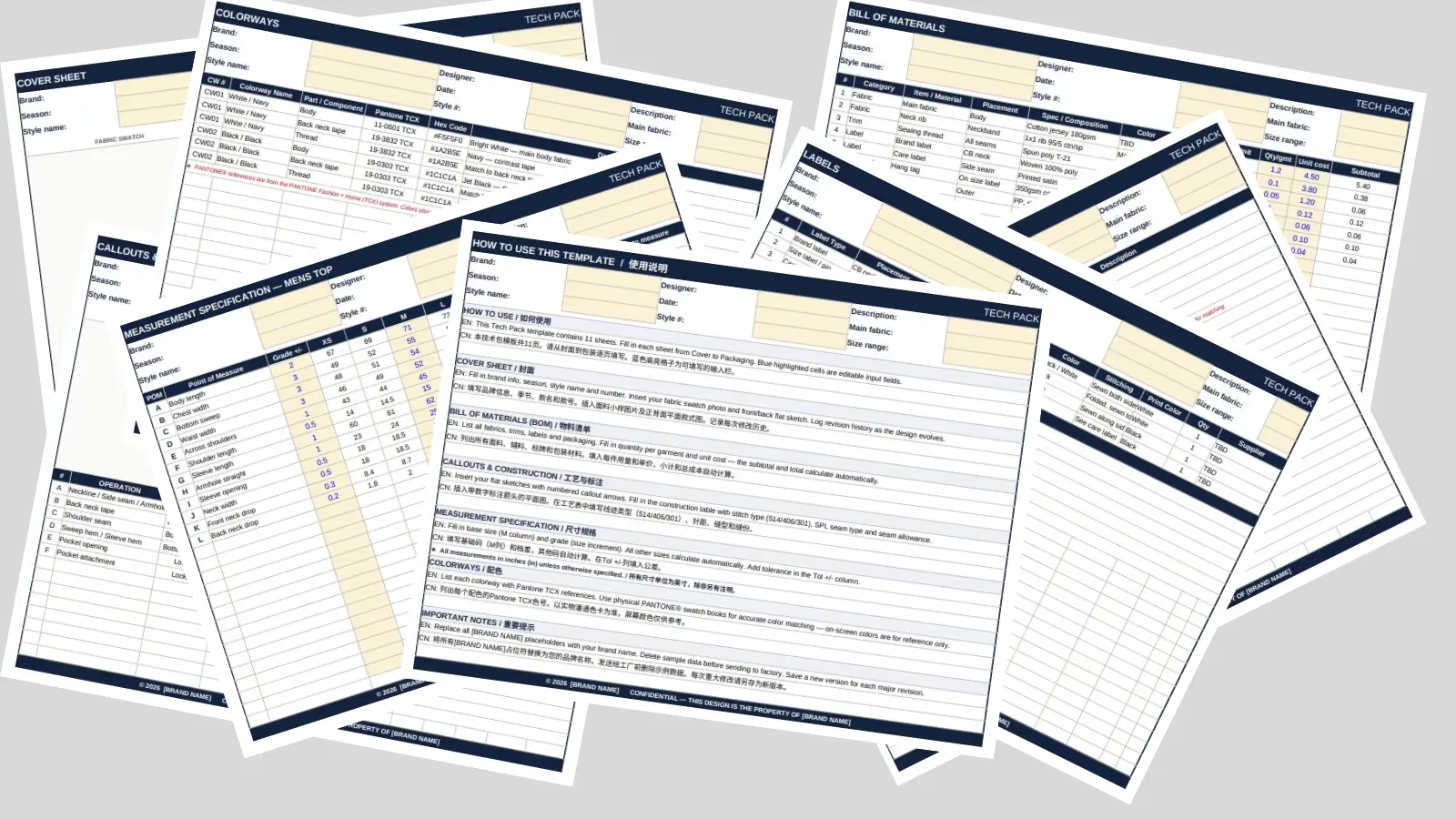
- Cover sheet — style name, style number, season, and a flat sketch or photo so there's no ambiguity about which garment this is
- Bill of Materials (BOM) — every fabric, trim, label, and packaging component, with supplier, quantity per garment, and cost, so nothing gets substituted without you knowing
- Measurement spec — every size, every measurement point, with grading between sizes and an acceptable tolerance for each
- Construction & callouts — stitch types, seam allowances, and stitches-per-inch for every operation, mapped onto a labeled flat sketch
- Colorways — Pantone references for every colorway, applied to every component
- Artwork — placement, dimensions, and file format for any print or embroidery
- Labels & packaging — what goes where, what material, how the finished garment is folded and bagged
The part most tech packs get wrong
A tech pack can have every section filled in and still generate a dozen back-and-forth emails before production starts. Two sections almost always need more detail than people give them:
Construction notes. “Sew the seams” isn't a construction note. Stitch type, seam allowance, and stitches per inch are what actually control how the finished garment looks and holds up — and factories build to whatever's written, not what you assumed was obvious.
Factories build to whatever's written, not what you assumed was obvious.
Tolerance. Every measurement needs an acceptable range, not just a target number. Without it, a factory has no way to know if a quarter-inch off is a defect or normal variation — and you'll find out which one they decided it was after the goods arrive.
Where to go from here
Building a tech pack from scratch, section by section, takes time most independent designers don't have on their first collection. Our Tech Pack template covers all of the above — cover sheet through packaging, 11 pages, already structured the way a factory expects to receive it.